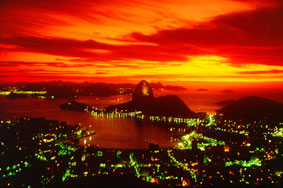
Rio de Janeiro, Brazil at dusk
To understand how tropicalismo became a public spectacle that served as a form of cultural resistance, it is important to understand the key elements of the contemporary situation of the country. The music of this moment tended to be related to MPB (música popular brasileira) or the Jovem Guarda, which had its sources in foreign rock. While MPB found its roots in protest music of the past, and the Jovem Guarda avoided social and political critique, tropicalismo chose to focus on developing a culture that was both modern and Brazilian that also responded to the problems of the country's political circumstances. Moreover, to share its new vision of what it meant to be Brazilian, tropicalismo demonstrated its different ideas during festivals and on televsion programs, using the media to amplify its message. As we will see in the following pages, all of these elements gave tropicalismo a revolutionary importance that continued to be very Brazilian.