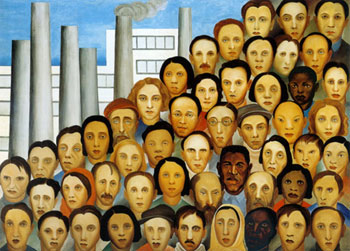
el cuadro Operarios (Workers) by Tarsila do Amaral
To understand the reason why the tropicalismo cultural movement decided to use the media, it is important to know that the military government also used it for its own interests. According to Lidia Santos, the dictatorship had tried to convince the public of the possibilities of progress that it hoped to bring to the country with advertisements on television, and this fact served as inspiration for the tropicalistas (61). Tropicalismo reappropriated the media for the public and rejected the conservative nature of the military government with extravagant spectacles
As we have already seen, the televised festivals of Brazilian music were very popular among people of various social classes, so tropicalismo could diffuse its vision of cultural revitalization using this method. For this reason, the use of television allowed this fusion of known styles and contemporary elements to complete, converting into an event seen by people of various ideological backgrounds. Santos notes that the use of the media expanded the impact of the allegory represented in the songs (83). In this way, what the tropicalistas did was modernize their music and their intentions with technology. Their songs arrived to the public immediately, and did not need commercial success or the approval of those people who watched the show.
Further, the shows of tropicalismo intesified the element of imitation to exaggerate and criticize the convetions of various social classes, as well as the stereotypes about what it meant to be Brazilian. For example, Caetano Veloso tended to wear colorful clothes and extravagent and futuristic styles with primitive adornment. Gilberto Gil decided to use African-style clothes to demonstrate his heritage with pride, instead of hiding it because of the racism prevalent in society (Dunn 133). The tropicalistas also exaggerated the tensions between the Brazilian cultural camps with musicians dressed in the style of the Beatles or rock. As such, the tropicalista spectacle shown using the media suggested possibilities still not considered by the public and tried to arrive at a new definition of the intentions of popular Brazilian music.