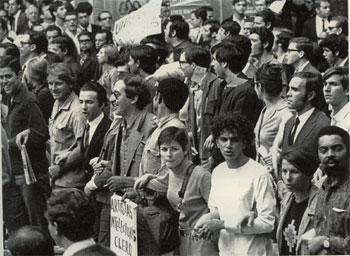
Chico Buarque, Arduinho Colazanti, Renato Borghi, Zé Celso, Paulinho da Viola
Dedé Veloso, Caetano Veloso, Nana Cayammi, and Gilberto Gil during the March of 100,000 on June 26, 1968
During the 1960s, the Brazilian government was controlled by a military dictatorship; in 1968, the president was Artur da Costa e Silva. This dictatorship used repressive methods to maintain its control of the Brazilian public, but those people who did not support the military government attempted to protest its actions and change the state of things. A key demonstration with the March of 100,000 which denounced repression, censorship, and the treatment of students, as you can see in the above photo. Although there were no violent incidents in this march, the government decided to prohibit public demonstrations, which indicated the form of cultural repression that was beginning in Brazil.
Due to the government's actions and the socio-economic inequality in Brazil, the music of tropicalismo did not only respond to the state of culture, but also to the situation within the country. In this way, the sophistication of the words of the songs reflected national problems, and the music appealed to the public and enabled the tropicalistas to share this message. For this reason, the tropicalistas's use of the media to enable their music to reach a broader public became a demonstration of cultural resistence.