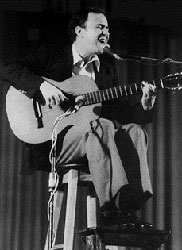
Photo of João Gilberto, the master of bossa nova
Brazilian popular music tradition is full of interesting styles and unforgetable characters. Among the most important are samba and bossa nova. Samba has a rich tradition in Brazil, which extends from the sambas-canções of carnival to other forms of samba with less dancable, different rhythms. In the international setting, Carmen Miranda is more well-known due to her success in the United States; she projected a famous image of a sensualized Brazilian mestiza. As Veloso says, the world recognized Carmen Miranda not for the way she sang, but for the stereotypes of Brazil that her image suggested (167). At the same time, the use of the media to share this concept of what is Brazilian was a method respected by and useful for the tropicalistas.
Without doubt, the most familiar musical style at this time was bossa nova, which evolved from a Brazilian jazz tradition popularized by Antonio Carlos Jobim. João Gilberto, the master of bossa nova, according to Caetano Veloso, invented the guitar rhythm called batida and the vocal style that defined this type of music (Dunn 29). For Veloso, bossa nova was a refined way to transform Brazilian culture, through an evaluation and understanding of popular tastes, Brazilian musical heritage, such as samba and Afro-Brazilian rhythms, and belief in the possibility of creating a new style. In this way, Veloso states, Gilberto proposed a personal interpretation of the spirit of samba (22). With the fusion of jazz and samba, bossa nova reflected its Brazilian roots, assimilated the musical vanguard, and found a way to maintain both elements to construct a style of music that loyally represented Brazil and could also enter the international market.
From these musical styles, tropicalismo learned the possibilities of modernizing Brazilian culture and maintaining the important relationship with the past. For this reason, the tropicalistas used imitation to construct their own form of expression that still reflected the possibilities evident in its musical predecessors.